
Transformer Calculator
Sizing a transformer comes down to a few formulas: kVA from volts and amps, full-load current on each side, and a margin for growth. Enter your system and load, and this calculator works out the kVA needed, suggests the next standard size and shows the currents and fault level on each side.
- Free to use
- No sign-up
- Runs in your browser
Transformer calculator
Transformer Sizing Pack
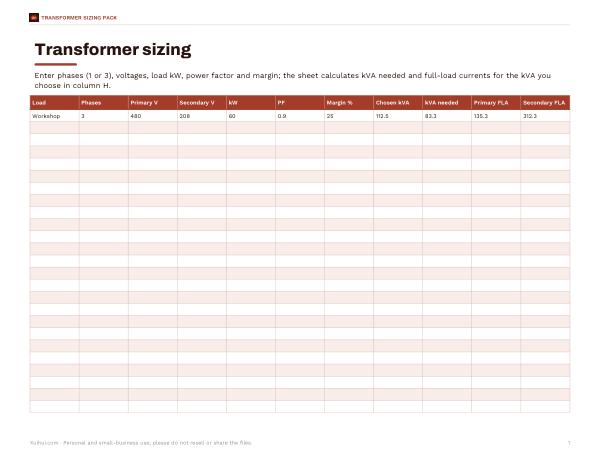
Excel transformer sizing workbook, printable full-load amps tables for single- and three-phase sizes, a transformer nameplate record sheet and a sizing checklist.
- Sizing workbook (XLSX)
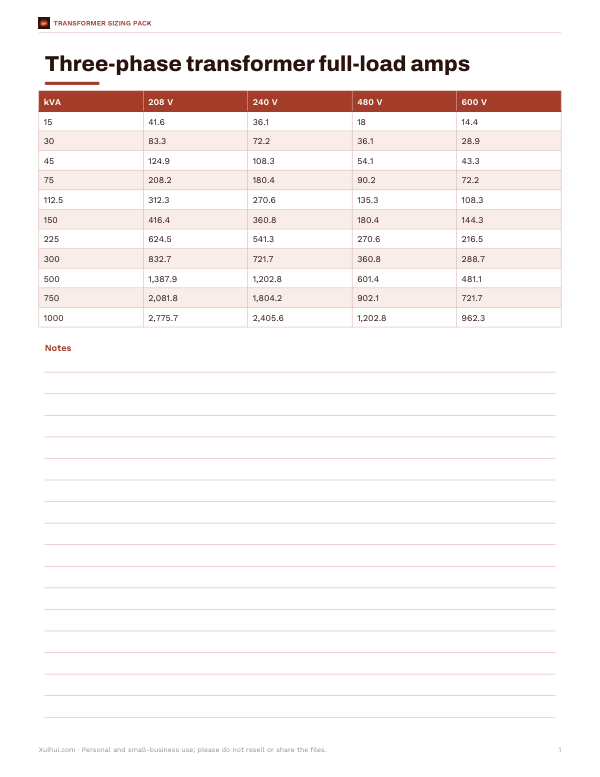
- 3-phase FLA (PDF)
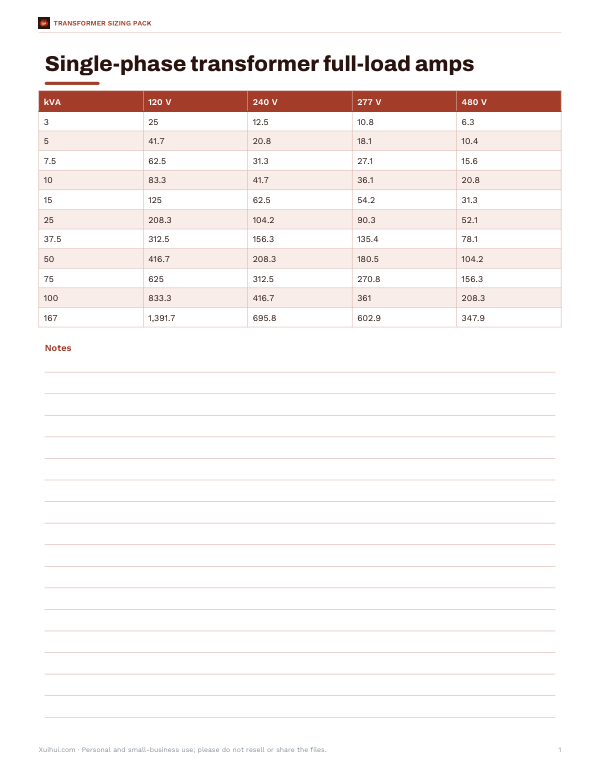
- 1-phase FLA (PDF)
- Nameplate record (PDF/DOCX/XLSX)
- Sizing checklist (PDF/DOCX)
Formats: XLSX, PDF, DOCX. Instant download after payment (link valid 72 hours, up to 5 downloads). AI-assisted: the templates were drafted with AI help and reviewed and laid out before publishing.
$3.00 USD, one-time 5 files · about $0.60 each
- Instant download
- 7-day refund
- Secure checkout by Stripe
7-day money-back guarantee. Full refund within 7 days of purchase, even after you download.
Free sample: FLA Single Phase (PDF, 58 KB)
Full refund within 7 days — see the refund policy and license.
Free printables
Single sheets you can print right now, no sign-up. The full pack adds every sheet in one download plus the editable files.
 Transformer Nameplate Record Sheet
 Printable Transformer Sizing Checklist
Transformer formulas
| Quantity | Single-phase | Three-phase |
|---|---|---|
| kVA from volts and amps | V × I ÷ 1,000 | √3 × V × I ÷ 1,000 |
| Full-load amps | kVA × 1,000 ÷ V | kVA × 1,000 ÷ (√3 × V) |
| kVA from kW | kW ÷ power factor | kW ÷ power factor |
| Turns ratio (ideal) | Vprimary ÷ Vsecondary = Nprimary ÷ Nsecondary | Same, using line voltages for like connections |
| Fault current (infinite source) | FLA × 100 ÷ %Z | FLA × 100 ÷ %Z |
Transformers are rated in kVA rather than kW because their heating depends on current and voltage, regardless of the load’s power factor.
Full-load amps for common three-phase sizes
| kVA | 208 V | 240 V | 480 V | 600 V |
|---|---|---|---|---|
| 15 | 41.6 | 36.1 | 18.0 | 14.4 |
| 30 | 83.3 | 72.2 | 36.1 | 28.9 |
| 45 | 124.9 | 108.3 | 54.1 | 43.3 |
| 75 | 208.2 | 180.4 | 90.2 | 72.2 |
| 112.5 | 312.3 | 270.6 | 135.3 | 108.3 |
| 150 | 416.4 | 360.8 | 180.4 | 144.3 |
| 225 | 624.5 | 541.3 | 270.6 | 216.5 |
| 300 | 832.7 | 721.7 | 360.8 | 288.7 |
| 500 | 1387.9 | 1202.8 | 601.4 | 481.1 |
Full-load amps for common single-phase sizes
| kVA | 120 V | 240 V | 277 V | 480 V |
|---|---|---|---|---|
| 5 | 41.7 | 20.8 | 18.1 | 10.4 |
| 10 | 83.3 | 41.7 | 36.1 | 20.8 |
| 15 | 125.0 | 62.5 | 54.2 | 31.3 |
| 25 | 208.3 | 104.2 | 90.3 | 52.1 |
| 37.5 | 312.5 | 156.3 | 135.4 | 78.1 |
| 50 | 416.7 | 208.3 | 180.5 | 104.2 |
| 75 | 625.0 | 312.5 | 270.8 | 156.3 |
| 100 | 833.3 | 416.7 | 361.0 | 208.3 |
| 167 | 1391.7 | 695.8 | 602.9 | 347.9 |
Worked example
A 60 kW three-phase load at 0.9 power factor is 60 ÷ 0.9 = 66.7 kVA. Adding a 25% margin gives 83.3 kVA, so the next standard size is 112.5 kVA. On a 480 V primary the full-load current is 112,500 ÷ (1.732 × 480) = 135.3 A; on the 208 V secondary it is 312.3 A. With 5% impedance, the maximum available fault current at the secondary is about 6.2 kA — a figure that matters for choosing breakers with a high enough interrupting rating.
Standard kVA ratings
| Type | Common ratings (kVA) |
|---|---|
| Single-phase | 3, 5, 7.5, 10, 15, 25, 37.5, 50, 75, 100, 167, 250 |
| Three-phase | 15, 30, 45, 75, 112.5, 150, 225, 300, 500, 750, 1000, 1500, 2000, 2500 |
Available sizes vary by manufacturer and type (dry-type, pad-mounted, pole-mounted).
Common transformer connections
| Connection | Typical use |
|---|---|
| Delta–wye (Δ–Y) | Commercial buildings: 480 V delta primary to 208Y/120 V secondary |
| Wye–wye (Y–Y) | Utility distribution; needs care with neutrals and harmonics |
| Delta–delta (Δ–Δ) | Industrial three-phase power without a neutral |
| Single-phase 120/240 V | Homes and light commercial: centre-tapped secondary |
A delta–wye transformer provides a neutral on the secondary for 120 V single-phase loads, which is why 480–208Y/120 V units are so common in commercial buildings.
kVA, kW and power factor
Real power (kW) does useful work; apparent power (kVA) is what the transformer must supply, including reactive power used by motors and other inductive loads. The ratio kW ÷ kVA is the power factor. A load of 60 kW at a power factor of 0.8 needs 75 kVA of transformer capacity, while the same 60 kW at unity power factor needs only 60 kVA — one reason facilities correct low power factor.
Efficiency and losses
Transformers lose a little energy as heat — core losses whenever they’re energised, and copper (winding) losses that rise with the square of the load current. Energy-efficiency regulations in many countries set minimum efficiencies for distribution transformers. Because a transformer that is lightly loaded most of the time still has core losses, oversizing far beyond the load isn’t free; a sensible growth margin is the usual compromise.
Sizing considerations
- Add a margin for future load growth — 20–25% is common.
- Motor starting currents can cause large voltage dips; large motors may need a bigger transformer or soft starters.
- Non-linear loads (drives, rectifiers, many electronics) create harmonics that heat transformers; K-rated units may be specified.
- Ambient temperature and ventilation affect how much a transformer can carry.
- Primary and secondary protection and conductors are sized from the transformer rating under electrical codes.
Privacy
All calculations run in your browser.
Frequently asked questions
How do I calculate transformer kVA?
kVA = V × I ÷ 1,000 for single-phase, or √3 × V × I ÷ 1,000 for three-phase.
What is full-load current?
The current a transformer carries at its rated kVA.
Why are transformers rated in kVA and not kW?
Their heating depends on current and voltage, not on the load’s power factor.
What size transformer do I need?
Load kVA plus a growth margin, rounded up to the next standard size.
What does %Z mean?
Percent impedance: the voltage needed to drive full-load current through a shorted secondary, as a percentage of rated voltage.
Does this replace an engineer?
No — follow code requirements and professional design for installations.
What is a step-down transformer?
One whose secondary voltage is lower than its primary, such as 480 V to 208 V.
Can a transformer be run in reverse?
Many dry-type transformers can be back-fed for step-up use, but check with the manufacturer first — protection and inrush differ.
What is inrush current?
A brief surge when a transformer is first energised, which protective devices must tolerate.